This is default featured slide 1 title

Go to Blogger edit html and find these sentences.Now replace these sentences with your own descriptions.This theme is Bloggerized by Lasantha Bandara - Premiumbloggertemplates.com.

This is default featured slide 2 title

Go to Blogger edit html and find these sentences.Now replace these sentences with your own descriptions.This theme is Bloggerized by Lasantha Bandara - Premiumbloggertemplates.com.

This is default featured slide 3 title

Go to Blogger edit html and find these sentences.Now replace these sentences with your own descriptions.This theme is Bloggerized by Lasantha Bandara - Premiumbloggertemplates.com.

This is default featured slide 4 title

Go to Blogger edit html and find these sentences.Now replace these sentences with your own descriptions.This theme is Bloggerized by Lasantha Bandara - Premiumbloggertemplates.com.

This is default featured slide 5 title

Go to Blogger edit html and find these sentences.Now replace these sentences with your own descriptions.This theme is Bloggerized by Lasantha Bandara - Premiumbloggertemplates.com.

Minggu, 17 Juli 2016

Free Ebook , by Steffen Kjaer

Free Ebook , by Steffen Kjaer

It's coming again, the new collection that this website has. To finish your inquisitiveness, we offer the preferred book as the choice today. This is a publication that will certainly reveal you also new to old thing. Forget it; it will certainly be right for you. Well, when you are actually passing away of , By Steffen Kjaer, simply select it. You recognize, this publication is always making the followers to be dizzy if not to find.

, by Steffen Kjaer

, by Steffen Kjaer


, by Steffen Kjaer


Free Ebook , by Steffen Kjaer

When you are hurried of work target date as well as have no suggestion to obtain motivation, , By Steffen Kjaer book is among your options to take. Schedule , By Steffen Kjaer will certainly provide you the appropriate source and also point to get motivations. It is not just regarding the works for politic business, management, economics, and also other. Some bought tasks making some fiction jobs also require motivations to get rid of the work. As exactly what you need, this , By Steffen Kjaer will possibly be your option.

Knowing many books may not verify you to be a better individual. Yet understanding as well as reading publications will certainly make you really feel much better. Reserve at the tool to get to successful is sensible words that are uttered by some people. Do you think it? Maybe, only few individuals that such as the words and count on those words. However, you must think it because publication can bring you far better thing as supposed as the aims of reading and also publications. As the , By Steffen Kjaer that we offer, this is not sort of nonsense publication that will affect absolutely nothing.

In checking out , By Steffen Kjaer, now you could not likewise do conventionally. In this contemporary age, device as well as computer system will certainly aid you so much. This is the moment for you to open the device and remain in this website. It is the best doing. You can see the connect to download this , By Steffen Kjaer here, cannot you? Merely click the link and make a deal to download it. You can get to purchase guide , By Steffen Kjaer by online as well as ready to download. It is really various with the traditional method by gong to guide establishment around your city.

understanding even more regarding this book, you could reveal just how this book is crucial for you to check out. This is just one of the reasons you need to review it. However, the here and now , By Steffen Kjaer can be recommended to get rid of the troubles that you encounter now, probably. Also you have the appropriate choice, getting info as well as considerations from a few other sources are requirement. You may have a lot more times to learn about the troubles as well as how you can address it. When you need home entertainment to make enjoyable, you could obtain some from this publication.

, by Steffen Kjaer

Product details

File Size: 25146 KB

Print Length: 70 pages

Publisher: Alpine Avenue Books (December 18, 2013)

Publication Date: December 18, 2013

Sold by: Amazon Digital Services LLC

Language: English

ASIN: B00BQKSXTI

Text-to-Speech:

Enabled

P.when("jQuery", "a-popover", "ready").execute(function ($, popover) {

var $ttsPopover = $('#ttsPop');

popover.create($ttsPopover, {

"closeButton": "false",

"position": "triggerBottom",

"width": "256",

"popoverLabel": "Text-to-Speech Popover",

"closeButtonLabel": "Text-to-Speech Close Popover",

"content": '

' + "Text-to-Speech is available for the Kindle Fire HDX, Kindle Fire HD, Kindle Fire, Kindle Touch, Kindle Keyboard, Kindle (2nd generation), Kindle DX, Amazon Echo, Amazon Tap, and Echo Dot." + '
'

});

});

X-Ray:

Not Enabled

P.when("jQuery", "a-popover", "ready").execute(function ($, popover) {

var $xrayPopover = $('#xrayPop_5C1FB09E53EC11E98F08213293D580DF');

popover.create($xrayPopover, {

"closeButton": "false",

"position": "triggerBottom",

"width": "256",

"popoverLabel": "X-Ray Popover ",

"closeButtonLabel": "X-Ray Close Popover",

"content": '

' + "X-Ray is not available for this item" + '
',

});

});

Word Wise: Enabled

Lending: Not Enabled

Screen Reader:

Supported

P.when("jQuery", "a-popover", "ready").execute(function ($, popover) {

var $screenReaderPopover = $('#screenReaderPopover');

popover.create($screenReaderPopover, {

"position": "triggerBottom",

"width": "500",

"content": '

' + "The text of this e-book can be read by popular screen readers. Descriptive text for images (known as “ALT text”) can be read using the Kindle for PC app and on Fire OS devices if the publisher has included it. If this e-book contains other types of non-text content (for example, some charts and math equations), that content will not currently be read by screen readers. Learn more" + '
',

"popoverLabel": "The text of this e-book can be read by popular screen readers. Descriptive text for images (known as “ALT text”) can be read using the Kindle for PC app if the publisher has included it. If this e-book contains other types of non-text content (for example, some charts and math equations), that content will not currently be read by screen readers.",

"closeButtonLabel": "Screen Reader Close Popover"

});

});

Enhanced Typesetting:

Enabled

P.when("jQuery", "a-popover", "ready").execute(function ($, popover) {

var $typesettingPopover = $('#typesettingPopover');

popover.create($typesettingPopover, {

"position": "triggerBottom",

"width": "256",

"content": '

' + "Enhanced typesetting improvements offer faster reading with less eye strain and beautiful page layouts, even at larger font sizes. Learn More" + '
',

"popoverLabel": "Enhanced Typesetting Popover",

"closeButtonLabel": "Enhanced Typesetting Close Popover"

});

});

Amazon Best Sellers Rank:

#5,065,204 Paid in Kindle Store (See Top 100 Paid in Kindle Store)

, by Steffen Kjaer PDF
, by Steffen Kjaer EPub
, by Steffen Kjaer Doc
, by Steffen Kjaer iBooks
, by Steffen Kjaer rtf
, by Steffen Kjaer Mobipocket
, by Steffen Kjaer Kindle

, by Steffen Kjaer PDF

, by Steffen Kjaer PDF

, by Steffen Kjaer PDF

Sabtu, 16 Juli 2016

Download Ebook , by Mandy Aftel

Download Ebook , by Mandy Aftel

It will certainly believe when you are going to choose this e-book. This motivating , By Mandy Aftel book could be reviewed completely in specific time depending on exactly how usually you open up and read them. One to keep in mind is that every e-book has their own production to get by each viewers. So, be the excellent visitor and also be a better individual after reviewing this publication , By Mandy Aftel

, by Mandy Aftel

, by Mandy Aftel


, by Mandy Aftel


Download Ebook , by Mandy Aftel

Do not you assume that checking out books will give you extra advantages? For all sessions as well as sorts of publications, this is considered as one manner in which will lead you to obtain finest. Each publication will certainly have various declaration and different diction. Is that so? Exactly what regarding guide entitled , By Mandy Aftel Have you read about this publication? Begin; do not be so careless to recognize more regarding a publication.

When you are actually keen on what phone call as publication, you will have one of the most favorite book, won't you? This is it. We pertain to you to promote an intriguing book from an expert writer. The , By Mandy Aftel is the book that always comes to be a good friend. We promote that book in soft documents. When you have the soft documents of this book it will certainly reduce in reading as well as bringing it anywhere. But, it will not be as hard as the printed book. Due to the fact that, you could save the data in the gadget.

Reading the e-book , By Mandy Aftel by on the internet could be also done easily every where you are. It appears that waiting the bus on the shelter, waiting the listing for queue, or various other locations possible. This , By Mandy Aftel can accompany you during that time. It will certainly not make you really feel weary. Besides, by doing this will certainly likewise boost your life high quality.

However, even this book is produced based on the reality, one that is very fascinating is that the author is really clever to earn this publication easy to review and recognize. Valuing the wonderful readers to always have reviewing routine, every writer serves their finest in supplying their ideas and also works. Who you are and what you are does not come to be any type of large problem to get this publication. After visiting this website, you could check more concerning this book then find it to realize analysis.

, by Mandy Aftel

Product details

File Size: 3851 KB

Print Length: 258 pages

Publisher: North Point Press; 1st edition (April 1, 2011)

Publication Date: April 1, 2011

Sold by: Macmillan

Language: English

ASIN: B004VMWJDE

Text-to-Speech:

Enabled

P.when("jQuery", "a-popover", "ready").execute(function ($, popover) {

var $ttsPopover = $('#ttsPop');

popover.create($ttsPopover, {

"closeButton": "false",

"position": "triggerBottom",

"width": "256",

"popoverLabel": "Text-to-Speech Popover",

"closeButtonLabel": "Text-to-Speech Close Popover",

"content": '

' + "Text-to-Speech is available for the Kindle Fire HDX, Kindle Fire HD, Kindle Fire, Kindle Touch, Kindle Keyboard, Kindle (2nd generation), Kindle DX, Amazon Echo, Amazon Tap, and Echo Dot." + '
'

});

});

X-Ray:

Not Enabled

P.when("jQuery", "a-popover", "ready").execute(function ($, popover) {

var $xrayPopover = $('#xrayPop_AD88964044A011E9B36B141152815678');

popover.create($xrayPopover, {

"closeButton": "false",

"position": "triggerBottom",

"width": "256",

"popoverLabel": "X-Ray Popover ",

"closeButtonLabel": "X-Ray Close Popover",

"content": '

' + "X-Ray is not available for this item" + '
',

});

});

Word Wise: Enabled

Lending: Not Enabled

Enhanced Typesetting:

Enabled

P.when("jQuery", "a-popover", "ready").execute(function ($, popover) {

var $typesettingPopover = $('#typesettingPopover');

popover.create($typesettingPopover, {

"position": "triggerBottom",

"width": "256",

"content": '

' + "Enhanced typesetting improvements offer faster reading with less eye strain and beautiful page layouts, even at larger font sizes. Learn More" + '
',

"popoverLabel": "Enhanced Typesetting Popover",

"closeButtonLabel": "Enhanced Typesetting Close Popover"

});

});

Amazon Best Sellers Rank:

#287,761 Paid in Kindle Store (See Top 100 Paid in Kindle Store)

There is no doubting Mandy Aftel's nose. Its her writing that's open to question. Sorry, that's way too harsh. When Mandy waxes lyrical about perfume in general she goes all airy-fairy and loses me. But I'm glad I slogged through to the parts where she's really talking about what she really does. She gives a lot of hard-won information about the workings of each fragrance note, and how each one goes with the others. This knowledge must have taken her years to acquire and its very generous of her to share it. It'll save amateur perfumers a lot of costly errors. Even some of the jumbo-jumbo stuff about alchemy is kind of interesting.I do need to complain about the quality of the printing. The ink is grayer than black and the pages seem like they were laser printed rather than offset printed. Please upgrade this in the next printing.

Some reviewers seem to have wanted a recipe book. This book is so much more. You'll get basic how to information, but more importantly you'll get context to understand why and how scents work. The result will be to enable you to make creative decisions on your own. I loved this book and I'm going to read it again, and return frequently to passages i highlighted the first time through.

Bought this based off of a few reviews here and on another forum and they couldn't be farther from the truth. If you are buying this to get concrete ideas on how to create essential oil perfume, you're wasting your time. If you are just a beginner and know NOTHING about perfume making, this is a marginally decent read. But overall a huge waste of my time and will provide you with stupid simple beginner recipes for a handful of generic scents/smells. Apparently the only way you can learn about actual/true perfume making is to take classes or attend a perfume school, and of course those cost an arm and a leg. So my dream of becoming a hobby perfume maker is no more. So much wasted time in this book about history of perfume making and notes used, etc. So boring and a real snoozer.

It is worth purchasing and reading for the beginning natural, artistry perfumer or kitchen witch but probably not going to be an easy read for empirically minded chemistry types.This is a book by Mandy Aftel, the artist and professional perfumer. It is about her personal "alchemy" as it relates to the art of perfumery as she sees it. This is not an alchemy or science based perfumery text. It's one artisans personal and practical philosophy on the artistry of perfume making with some perfume history and practical information to be gleaned by the eager or tolerant and patient reader.Despite the authors extensive use of hyperbole and lack of clear organization of some of the material there is a lot to be gleaned from this book for beginners who aren't ready to dive head first into expensive or hard to find archaic perfumery texts or chemistry tomes. There are some tables of useful information that clearly outline which oil combinations are historically harmonious or that she finds harmonious and offers some simple formulas, harmonies and accords for the beginning perfumer to start with - although you will need at least $200-$300 worth of materials which you might already mostly have.This book is about perfumery and how to blend perfumes from traditional "natural" materials (essential oils, absolutes, concretes, natural fixatives and animal products predominantly) for beginning perfumers. It seems like most of the material in this book is aggregated from other historical sources but then again I don't think one can write about how to make perfumes without going into the historical blending of perfumery; it seems like every book I've read so far on the subject does the same thing including the more science based books.If you are wanting to learn more about the science of perfumery from a modern or more empirical perspective filled with technical information then this is definitely NOT the right book for you. If you are wanting an "inspirational", emotive filled how-to from the perspective of a professional artisan in order to get your feet wet then you will be able to glean useful information, it all depends on your leanings and/or tenacity - I didn't find it that inspiring personally. As an artist I got a lot out of it on a materials based and intuitive process kind of way. As an empirical leaning, science based beginning perfumer I was frustrated by the meanderings, hyperbole & lack of organization. The author comes from her personal experience and philosophy as a professional perfumer and relates her experience in a way that makes it sound like her religion. She writes some philosophically based opinions into the text as though they are fact so be aware of guru-ism. It is clear that the writer feels a strong connection with perfumery's historical alchemical, guild based and apothecary roots and her insight comes from her practical knowledge and experience as both a professional and artist. Some might find her writing style inspirational due to her frequent use of metaphor and grandiosity. Despite what I found to be mostly fluff I think the author does a pretty good job of bringing the material down to a human level and makes perfumery approachable enough to start blending for most people.In case you can't tell I'm not fond of her writing style and am of the opinion that her writing style (or lack thereof) tends to cloud some of the value this book offers in the way of practical information. I'm sure she is a wonderful perfumer but a writer she is not. The alchemical aspect is not readily apparent besides the authors use of some "alchemical" terminology, exaggerations and hyping up the mysterious aspects of historical processes of perfumery, life and biology for effect. My wife reads archaic alchemy texts and couldn't get half way through this book. It seems that the alchemical reference is more for effect and marketing chaff in the same way jazz bands like to over use it. I'm sure she is well meaning and I'm sure she knows quite a bit about the history and contemplative process of alchemy, especially as it applies to her craft but it doesn't really come across in a way that is specifically related to alchemy in general for you practical or laboratory alchemy types. Instead it comes across as another marketing piece for the Aftel franchise way of doing things.

I'm a practicing aromatherapist for 20 years who is self-taught for the most part. I've been wanting to make some vibrational sprays for my clients & customers, but didn't really know how to BLEND essential oils to get the outcome I wanted. It was basically hit or miss. This book gives a vast amount of practical information about how perfumery works: top, middle and base notes; categories of essences such as floral, fruity, woody, animal, earthy, resinous, balsamic, green, edible for Base notes; the 3 stages of the scent over time; essences that always go together well; how to create a blend for an individual, and much more. She gives a list of top, middle and base note essential oils to start with and what to add to your collection as you go along. Pages 60-64 explain exactly how to get to know each of your essences at the deepest level so that you can begin to see what blending the oils will result in. Then later in the book, she speaks in detail of the steps to creating a blend as well as giving recipes for blends such as how to make a top, middle and base chord blend, sensual blends, blends for meditation & bath, etc. Lots of information, recommended books, and resources for supplies. Very practical and the historical narratives are very interesting.

, by Mandy Aftel PDF
, by Mandy Aftel EPub
, by Mandy Aftel Doc
, by Mandy Aftel iBooks
, by Mandy Aftel rtf
, by Mandy Aftel Mobipocket
, by Mandy Aftel Kindle

, by Mandy Aftel PDF

, by Mandy Aftel PDF

, by Mandy Aftel PDF

Jumat, 15 Juli 2016

Download PDF The Leader Habit: Master the Skills You Need to Lead - in Just Minutes a Day

Download PDF The Leader Habit: Master the Skills You Need to Lead - in Just Minutes a Day

Discover the trick to enhance the lifestyle by reading this The Leader Habit: Master The Skills You Need To Lead - In Just Minutes A Day This is a kind of book that you need now. Besides, it can be your preferred publication to read after having this publication The Leader Habit: Master The Skills You Need To Lead - In Just Minutes A Day Do you ask why? Well, The Leader Habit: Master The Skills You Need To Lead - In Just Minutes A Day is a publication that has various particular with others. You could not have to understand that the writer is, just how popular the job is. As sensible word, never ever judge the words from which speaks, yet make the words as your good value to your life.

The Leader Habit: Master the Skills You Need to Lead - in Just Minutes a Day

The Leader Habit: Master the Skills You Need to Lead - in Just Minutes a Day


The Leader Habit: Master the Skills You Need to Lead - in Just Minutes a Day


Download PDF The Leader Habit: Master the Skills You Need to Lead - in Just Minutes a Day

After few time, lastly guide that we and also you await is coming. So alleviated to get this great book offered to present in this website. This is guide, the DDD. If you still really feel so hard to obtain the published book in guide store, you could accompany us once more. If you have ever before got guide in soft data from this publication, you could conveniently get it as the reference now.

By spending couple of times in a day to review The Leader Habit: Master The Skills You Need To Lead - In Just Minutes A Day, some experiences as well as lessons will be gotten. It will not relate to exactly how you must or take the tasks, however take the advantages of just how the lesson and perception t obtain. In this situation, this provided publication truly ends up being motivations for the people as you. You will constantly require new experience, won't you? Yet, occasionally you have no adequate money and time to undertake it. This is why, via this publication, you can get rid of the willingness.

And how this book will affect you to do much better future? It will certainly relate to how the viewers will get the lessons that are coming. As recognized, frequently many individuals will think that analysis can be an entryway to enter the new understanding. The understanding will affect exactly how you tip you life. Even that is difficult enough; people with high sprit might not really feel bored or give up understanding that principle. It's just what The Leader Habit: Master The Skills You Need To Lead - In Just Minutes A Day will certainly provide the ideas for you.

From some problems that exist from the books, we constantly come to be interested of how you will certainly get this book. But, if you really feel that tough, you could take it by complying with the web link that is supplied in this internet site. Find also the various other lists of guides that can be possessed as well as read. It will not limit you to just have this publication. Yet, when The Leader Habit: Master The Skills You Need To Lead - In Just Minutes A Day ends up being the front runner, just make it as real, as what you actually wish to seek for as well as get in.

The Leader Habit: Master the Skills You Need to Lead - in Just Minutes a Day

Product details

#detail-bullets .content {

margin: 0.5em 0px 0em 25px !important;

}

Audible Audiobook

Listening Length: 6 hours and 59 minutes

Program Type: Audiobook

Version: Unabridged

Publisher: Brilliance Audio

Audible.com Release Date: April 19, 2018

Whispersync for Voice: Ready

Language: English, English

ASIN: B07BNSPVR4

Amazon Best Sellers Rank:

Why are world-class athletes, composers, writers, and professionals just better than others? The Leader Habit, by best-selling author and CEO of Pinsight Martin Lanik, provides the answer. A different kind of practice is the name of the game.Before I go into what I love about this book, however, I need to say that I read a lot of books about leadership. Most are unoriginal at best, or altogether useless at worst. And then, every now and again, I read one that I mark up, tab, underline and keep on my desk for years and years. The Leader Habit is already marked up and going to be one that I turn back to for many years to come. It's a treasure trove of leadership effectiveness research and practical advice for developing new leadership habits.Here are three things that I love MOST about The Leader Habit, and one question that I am left with after reading it.First, the things that I love. Martin and his team at Pinsight have done their homework. This team has conducted original research to inform this book. These days there are way too many opinions and "celebrity turned leadership guru" books out there. They all say the same thing. But not The Leader Habit.The Leader Habit provides compelling psychological evidence for why forming better habits is the BEST WAY to improve your leadership effectiveness. Martin provides a simple evidence-based formula around the concept of "automaticity" that is based on a cue-behavior-reward principle.According to Dr. Lanik, "it doesn't matter whether you begin the habit cycle with the cue-behavior pairing or the behavior-reward pairing. The important thing to remember is that both a cue and reward need to be present for a behavior to turn into a habit" (p. 26).The second thing I love about The Leader Habit is that it makes forming good leadership habits practical and achievable. How many good habits do you have? Really, how many good one's--be honest with yourself! Do you eat five servings of vegetables everyday? Do you get at least 30 minutes of vigorous exercise everyday? I don't...I try to do these things but forming good habits is hard work.Dr. Lanik's book teaches us that forming good habits requires deliberate practice and, in order to stick, deliberate practice must be easy! What's more, The Leader Habit provides a step-by-step guide for putting your leadership workout together.The third thing that I love most about Dr. Lanik's book is the catalogue of core leadership skills that the Pinsight research team identified. There are 22 skills and 79 micro-behaviors that leaders need to practice to master that skill. Each skill includes:1. A definition of the skill and the supporting micro-behaviors;2. A brief description of why the skill is important;3. A list of telltale signs that you'd benefit from prove this skill;4. A description of the personality traits most aligned with this skill (i.e., who will find this skill intrinisically fun to practice);5. And, BEST OF ALL, each includes brief 5-minute exercises to help you develop that skill by turning micro-behaviors into habits!Finally, as a bonus, the last section of the book provides strategies for motivating and coaching others around these skills to help them develop effective leadership habits.After reading the book, however, I am left with one question: what role does accountability play in forming new habits? Lanik argues that "motivation is key" when it comes to forming new habits. But sometimes we have to form habits or hold others accountable for forming habits when they may not want to or like to form those habits. I suppose this question still leaves the age old question are the best leaders built or made a mystery. And, for now, I'm going to enjoy flipping back through the leadership behaviors that will make the biggest difference for me and my team.Thanks to Dr. Lanik and the Pinsight team for this truly valuable resource. I think every leader needs to buy three copies of this book: one for themselves, one for their successor, and one for a peer who could benefit from some new leadership habits.

The Leader Habit is highly readable and quickly grabbed and maintained my interest throughout. The book is based on the author's extensive research into the skills of successful leaders; explains how habits of successful leaders can be broken down into smaller, more manageable behaviors; and provides simple exercises to improve each micro behavior component. Taken together, these improved micro behaviors actually result in improved leadership habits and skills. Indeed, The Leader Habit represents a whole new, highly effective, approach to developing individual leadership skills through small, simple, daily exercises. Highly recommended!

As I read Martin Lanik’s book, The Leader Habit: Master the Skills You Need to Lead – In Just Minutes A Day, I thought of Joe.Joe was an effective leader. If he was at work on his computer and one of his team members came by to ask a question, Joe always did the same thing. He asked the team member to wait a moment while he closed a file. Then he turned around to the computer, did what he had to do, turned back around to the team member and said, “Okay. Now I’m all yours. What’s up?” Joe was like many of the effective leaders I’ve seen. The teams he led were productive and had high morale. It wasn’t because Joe was a “great motivator.” He wasn’t a brilliant thinker. He didn’t know some secret known only to great leaders. Joe and other great leaders I’ve seen in action got results because they repeated basic, effective behaviors over and over and over. That’s the first big insight that underlies this book. If you want to be an effective leader, you need to master basic leadership habits.How will you learn those habits? If your experience is typical, you’ll attend a training session that’s at least one day long. That session will cover a lot of material with stress on knowledge rather than practice. You’ll head back to work where you try to remember the most important parts and put them into action. Most leadership training today happens in large, widely-spaced chunks. Not the best way to learn to be an effective leader.Those two insights are the core message of Martin Lanik’s book. You need to master critical leadership habits one at a time, practicing each one until you get it right. His book promises to help you do that, in just five minutes a day. That’s where the trouble starts. The book is not up to the quality of the ideas. The book begins with a simple example that gets your hopes up about the entire book. Then it wanders off into a long discussion of the theory behind Lanik’s methods. I noticed that one Amazon reviewer said that was where the value is in the book. I disagree. Lanik could put most of that material about how he developed the model in an appendix. The value of the book is in the how-to parts.That’s another problem. Lanik and his team have identified 22 leadership skills. That’s a lot. But there’s more. To “master” those skills, you need to master 79 micro-behaviors, developing each as a habit. According to Lanik’s research, it will take you 66 days to master each micro-behavior. If you do the math, that comes out to 14 years. To be fair, Lanik tells you how to develop the best keystone habits to give you the biggest bang for your buck as soon as possible. You must choose what micro-behaviors to work on first by analyzing your strengths and weaknesses and personality. None of that is easy. When you get down to the details of the skills and micro-behaviors, things can get messy. For example, Lanik calls one of the key skills “Create urgency.” The first micro-behavior for this skill is “Set bold and audacious goals for self and others; these goals are achievable but provide comfortable stretch for everyone.”Let’s leave aside the part about setting goals for others and whether that’s a good idea. If you’ve ever tried to set goals for yourself that are both bold and doable, you know that’s difficult. The exercises don’t help you much. And they don’t even address setting goals for others and how you might go about that.There’s helpful stuff here, but it will be hard to get value from it. It will take a lot of work. It will be a complicated project. And you must do a lot on your own. That’s not a recipe for success.Get value from this book by remembering the key points. Effective leaders develop effective leadership habits. Work on one small thing at a time. Keep getting better, a little bit every day. That’s a good way to develop leadership skills.If you want to get more than that from the book do it with an accountability partner or a coach. They will help you work through the analysis. You’ll get precious feedback from another person. And you will be more likely to stay with it because you’re committed to that person. In A NutshellThe Leader Habit gives you a way to develop effective leadership habits and become a better leader. Unfortunately, the author’s system is complicated. It will take a lot of work to understand, do the analysis, and put it all into practice. The book is not as helpful for that as having another person work with you to master the material.

As a busy professional, I needed an insightful yet practical book to help me build life-long habits specific to leadership skills. Like training for a marathon, effective leadership takes practice. In the Leader Habit, Martin Lanik provides an excellent framework to modify your behavior, and build leadership skills through daily exercises.

The first half of the book is where all the meat is. The reason I only give it four stars is the habits he discusses can bore the reader. I recommend finding one and focusing on that one and then skip ahead to finish off the last few chapters.

I found this book interesting and helped me pinpoint what I need to work on. A very good read, worth it.

A well though out and effective method to facilitate growth. One of the best books on coaching that I have read. Useful in all areas of life.

Helpful process to developing leadership skills, easy and engaging to read!

The Leader Habit: Master the Skills You Need to Lead - in Just Minutes a Day PDF
The Leader Habit: Master the Skills You Need to Lead - in Just Minutes a Day EPub
The Leader Habit: Master the Skills You Need to Lead - in Just Minutes a Day Doc
The Leader Habit: Master the Skills You Need to Lead - in Just Minutes a Day iBooks
The Leader Habit: Master the Skills You Need to Lead - in Just Minutes a Day rtf
The Leader Habit: Master the Skills You Need to Lead - in Just Minutes a Day Mobipocket
The Leader Habit: Master the Skills You Need to Lead - in Just Minutes a Day Kindle

The Leader Habit: Master the Skills You Need to Lead - in Just Minutes a Day PDF

The Leader Habit: Master the Skills You Need to Lead - in Just Minutes a Day PDF

The Leader Habit: Master the Skills You Need to Lead - in Just Minutes a Day PDF

Selasa, 12 Juli 2016

Free Ebook Biology's First Law: The Tendency for Diversity and Complexity to Increase in Evolutionary Systems

Free Ebook Biology's First Law: The Tendency for Diversity and Complexity to Increase in Evolutionary Systems

you are not kind of perfect person, yet you are a good person who constantly attempts to be better. This is one of the lessons to get after reviewing Biology's First Law: The Tendency For Diversity And Complexity To Increase In Evolutionary Systems Checking out will not make you feel careless. It will certainly make you more persistent to undertake your life and your tasks. To check out guide, you could not need to compel it entirely ended up basically time. Get the soft data and also you could handle when you wish to start reading when you will complete this book to read.
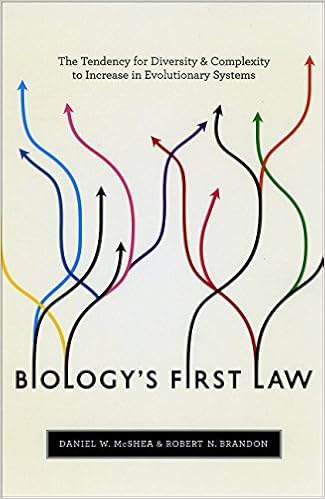
Biology's First Law: The Tendency for Diversity and Complexity to Increase in Evolutionary Systems

Biology's First Law: The Tendency for Diversity and Complexity to Increase in Evolutionary Systems


Biology's First Law: The Tendency for Diversity and Complexity to Increase in Evolutionary Systems


Free Ebook Biology's First Law: The Tendency for Diversity and Complexity to Increase in Evolutionary Systems

Ended with your extra time and also have no concept the best ways to do? Get the Biology's First Law: The Tendency For Diversity And Complexity To Increase In Evolutionary Systems as well as take it as your reading book. Why should read? Some people will assume that this is a really lazy and also monotonous task to do. In addition, many with leisure usually think that they are free. That's not the time for knowing. Well, reads only for your when learning or researching something? Definitely that's not.

When other peoples still really feel so difficult to discover this publication, you could not encounter that trouble. Your method to use the web connection and participate in this website is right. You could find the source of guide as Biology's First Law: The Tendency For Diversity And Complexity To Increase In Evolutionary Systems that will certainly not run out whenever. For making wonderful condition, it becomes one of the ways that lead you to always use as well as utilize the advanced innovation.

You recognize, as the benefit of reading this Biology's First Law: The Tendency For Diversity And Complexity To Increase In Evolutionary Systems, you could not just get brand-new understanding. You will certainly really feel so enjoyable and also delightful when reading it. It proves by the existence of this book, you could use the time completely. Spending the moment when being at home will work enough when you know really just what need to do. Reviewing is one of the best ways to do to accompany your spare time. Naturally, it will certainly be extra precious compared to only chatting to the various other buddies.

For more intriguing reason, you may unknown about the web content of this publication, may you? Why do not you try to understand? Understanding brand-new point will result in conceive the life much better. You could not only check out as the tasks, however analysis can be a method to make your life run well. By this Biology's First Law: The Tendency For Diversity And Complexity To Increase In Evolutionary Systems you can truly think of exactly how the life will certainly be and should be.

Biology's First Law: The Tendency for Diversity and Complexity to Increase in Evolutionary Systems

Review

“"Biology''s First Law" is an original and unusual book. A hybrid of theoretical biology and philosophy of science, it addresses both conceptual and empirical problems…a thought-provoking study.”—Samir Okasha, "Nature" --Samir Okasha "Nature """Biology''s First Law" is an original and unusual book. A hybrid of theoretical biology and philosophy of science, it addresses both conceptual and empirical problems . . . a thought-provoking study./i>--Samir Okasha "Nature "

Read more

About the Author

Daniel W. McShea is Associate Professor of Biology, with a secondary appointment in Philosophy, andRobert N. Brandon is Professor of Philosophy, with a secondary appointment in Biology, both at Duke University.

Read more

Product details

Paperback: 184 pages

Publisher: University of Chicago Press (July 15, 2010)

Language: English

ISBN-10: 0226562263

ISBN-13: 978-0226562261

Product Dimensions:

6 x 0.5 x 9 inches

Shipping Weight: 11.8 ounces (View shipping rates and policies)

Average Customer Review:

2.9 out of 5 stars

8 customer reviews

Amazon Best Sellers Rank:

#1,376,419 in Books (See Top 100 in Books)

When animals have nothing to do they go to sleep. But humans have a drive to know and understand everything. Attentive humans noticed fossils and asked where they came from. Very intelligent humans invented the theory that life evolved over a period of 3.5 billion years. Marshaling the evidence, rational humans judge the theory to be true. Humans then ask: What caused evolution?Creationists and advocates of intelligent design think that God did it. While there is evidence that God exists (free will, finite beings), there is little evidence supporting this theory. There is no evidence supporting the theory of natural selection. This theory only explains how giraffes got long necks, not how giraffes evolved from bacteria. The reason is that a giraffe is so much more complex than a bacterium and 3.5 billion years is only about a hundred thousand trillion seconds (17 zeros). Not enough is known about the innovations natural selection acts upon for humans to understand how evolution occurred in so short a time. Evolutionary biologists generally speak of "adaptive evolution" in connection with natural selection.Atheists, creationists, and advocates of intelligent design are responsible for the misinformation that natural selection is intended as an explanation for the complexity of life. The author of the following quote has a Ph.D. in linguistics, not biology. Pinker is Steve Pinker (Ph.D. in linguistics), and Bloom is Paul Bloom (Ph.D. in psychology). Notice that Charles Darwin (Ph.D. in biology) doesn't think natural selection explains the complexity of the human eye:"They [Pinker and Bloom] particularly emphasized that language is incredibly complex, as Chomsky had been saying for decades. Indeed, it was the enormous complexity of language that made is hard to imagine not merely how it had evolved but that it had evolved at all."But, continued Pinker and Bloom, complexity is not a problem for evolution. Consider the eye. The little organ is composed of many specialized parts, each delicately calibrated to perform its role in conjunction with the others. It includes the cornea,...Even Darwin said that it was hard to imagine how the eye could have evolved."And yet, he explained, it did evolve, and the only possible way is through natural selection--the inestimable back-and-forth of random genetic mutation with small effects...Over the eons, those small changes accreted and eventually resulted in the eye as we know it." (Christine Kenneally, The First Word: The Search for the Origins of Language pp. 59-60)McShae and Brandon state the limitations of natural selection explicitly:"The history of life presents three great sources of wonder. One is adaptation, the marvelous fit between organism and environment. The other two are diversity and complexity, the huge variety of living forms today and the enormous complexity of their internal structure. Natural selection explains adaptation. But what explains diversity and complexity?" (location 78, Kindle)The second bit of nonsense McShae and Brandon refute is the idea that evolution obeys the second law of thermodynamics. In November, 2008, the American Journal of Physics published an article "Entropy and evolution" that includes an absurd equation combining thermodynamics and probability theory to prove that evolution does NOT violate the second law of thermodynamics. The article was probably written in good faith because there are a lot of books and articles about evolution and the second law of thermodynamics.According to the second law of thermodynamics, a gas will fill up the entire container it is in because this is the most probable distribution of non-interacting molecules. In other words, nature goes from knowledge to lack of knowledge about the location of molecules, order to disorder, complexity to simplicity, or low entropy to high entropy. When shuffling a deck of playing cards the chance of the deck getting back into its original factory order is about one in 10, 000 vigintillion (67 zeros). I mention cards because physicists label the molecules in a gas No. 1, No. 2, etc. and a deck of playing cards comes automatically labeled. Notice that there are almost four times as many zeros in this number as in the time for evolution.In trying to understand evolution, biologists use as a model for a protein, not a deck of playing cards, but the English sonnet. A protein has four levels of complexity, but the primary structure has hundreds of amino acids and each amino acid has to be in exactly the right location for the protein to work. As there are 20 amino acids and 26 letters, biologists calculate how long it would take a computer to generate a sonnet by the random selection of letters. (Marc Kirschner and John Gerhart, The The Plausibility of Life: Resolving Darwin's Dilemma, pages 32).Kirschner and Gerhart only report a calculation simulating natural selection for a the phrase "to be or not to be." My guess is that nobody did the calculation for a sonnet because nobody cares. The primary structure of a protein doesn't even begin to describe the complexity of life. The dozens of proteins that make the flagellum of a bacterium rotate is a static kind of complexity, like the primary structure of a protein. By contrast, genetic engineering is the ability of cells to detect changes in the environment and create new proteins in response to the change. The ability of a fertilized animal egg to develop into a multicellular animal is another example of complexity. The instinctual behavior of animals and the knowledge of grammar that human infants are born with are other "sources of wonder," as the authors express it.The only connection between evolution and the second law of thermodynamics is that evolutionary biologists and physicists both perform probability calculations. The AJP article singles out for criticism the creationist Henry Morris for saying evolution violates the second law of thermodynamics. The article argues that the second law only applies to closed systems without mentioning the criterion that it only applies to non-interacting particles.The second law of thermodynamics does not apply to very large numbers of hydrogen atoms in outer space because the force of gravity causes stars to be formed from these atoms. A living organism is anything but a system of non-interacting particles. This is the real reason evolution does not violate the second law. With the goal of understanding evolution, the earth is a closed system. It is true that the sun bathes the earth with its energy. But energy from the sun generally heats things up and makes them more disordered, not less disordered.This is the way the McShae and Brandon explain that the complexity of life has nothing to do with the second law of thermodynamics:"Based on what we have said so far, some will be poised and ready to make a leap, from the notion of accumulation of accidents to the second law of thermodynamics.... We advise readers against this, for their own safety. We are concerned that on the other side of that leap there may be no firm footing. Indeed, there may be an abyss. First, we think the foundation of the ZFEL [zero-force evolutionary law] lies in probability theory, not in the second law or any other law of physics. And second, our notions of diversity and complexity differ fundamentally from entropy, in that entropy, unlike diversity and complexity is not a level-related concept. " (location 220 on Kindle)

I found this book to present an interesting argument, but I was continually bothered by one of their basic conclusions related to the implications of random variation among independent groups.The authors assert that among two different groups whose components vary randomly and independently from each other, the two groups will be become more and more distinct from each other, on average, over time. I don't believe statistical theory supports this assertion.For example, two piles of leaves (a favorite analogy of the authors) are 100 ft. apart from each other. Random wind patterns may distribute the leaves in each pile randomly and the variation in the leaf movements are independent between the two piles. Over time, the both piles will be obliterated but if the wind patterns are truly random than the leaves in the first pile will, on average, still be 100 ft. from the leaves in the second pile, on average.If the authors do not consider average distinctness of one group of leaves or cells from another to be measured in this way, they do not explicitly describe how they would propose to measure it differently. I believe the issue would remain nonetheless.

I. Brief ThoughtsThis book posits the "Zero-Force Evolutionary Law", or ZFEL (which the authors suggest pronouncing like "zeffle"). The book is not long, but it is dense, and the authors are what an old professor of mine would call "good philosophers" -- they tell you what they are doing as they do it. The lines of reasoning are easy to follow, and examples, objections, and distinctions are offered in due course to make sure readers keep the discussion well sorted in their minds. The ZFEL, briefly put, is a hierachical and probabilistic explanation for the widespread observation that organisms tend to diversify and become more complex over time. The authors argue the ZFEL is the best null hypothesis in biological situations, and they point to a change in how we formulate biological explanation. They discuss both relevant empirical and philosophical points in a wide-ranging but deceptively simple book.- - - - - - -II. Further CommentThe ZFEL law is argued to be the fundamental background condition in any biological situation. Considering, as Dobzhansky put it, that nothing in biology makes sense except in the light of evolution, it will come as no surprise that "biology's first law" is an evolutionary law. It may come as a somewhat greater surprise that the ZFEL is distinct from natural selection. The ZFEL, though, is posited in a strongly neo-Darwinian context, and the authors argue strenuously that the ZFEL complements the principle of natural selection.Here is how the authors articulate the ZFEL:"In any evolutionary system in which there is variation and heredity, there is a tendency for diversity and complexity to increase, one that is always present but may be opposed or augmented by natural selection, other forces, or constraints acting on diversity and complexity."The simplest example the authors use is the accumulation of variation on the pickets of a fence. As paint flakes off, lichen appears, etc., the variation is hereditary (retained through time), and so as time progresses the pickets become increasingly different. Importantly, We can say either that the population of pickets becomes more *diverse* or that the fence becomes more *complex*. Typically, we speak of complexity when examining "down" to a smaller scale, such as cellular machinery, whereas we speak of diversity when looking "up" to a wider scale, such as an ecosystem. Both, however, refer to the number of constituents of some entity -- both are hierarchical. And anyone who's ever seen (or made) a phylogeny should recognize that evolution is manifestly hierarchical.Thus the authors point to evidence for the ZFEL, arguing "[t]he ZFEL is supported by an enormous amount of evidence, at every temporal and physical scale, at every level of organization, across biology." They specify that "[t]wo of the most compelling pieces of evidence" are "the increase in phenotypic diversity over the history of life and the rise in genomic complexity marked by the divergence of pseudogenes." Thus the ZFEL is a formalization of widespread patterns we are all familiar with. The authors argue that the pattern of increasing diversity/complexity is so pervasive that it constitutes the background condition, the null hypothesis of biology.It is helpful to contrast the zero-force expectation of the ZFEL against the Newtonian zero-force expectation. The nature of inertia dictates that an unperturbed object maintains its trajectory -- that, absent some additional force, an entity at rest remains the same. The ZFEL says that we should expect an entity to be different (or differentiated) at some later time, as a null expectation, in the absence of any intervening forces.It is also helpful to contrast the ZFEL against a pair of well regarded biological mechanisms: diversifying selection and drift. Both are already recognized as agents that increase diversity/complexity in the biosphere. The ZFEL subsumes these mechanisms with an important hierachical and probabilistic notion of respective randomness. Here is how the authors explain their position:"Consider this. Take a snapshot of all of the people on a crowded city street corner at some moment in the middle of the day. Then find these same people 10 minutes later. Find them again 20 minutes later, and then 30 minutes later. With the passage of time, they will become increasingly dispersed, or in other words, the variance in their locations will increase. And this is true even if the trajectory of each person is the deterministic outcome of his or her plans for that afternoon. One is on her way to her office. Another is walking his dog. A third is going grocery shopping. And so on. To the extent those motivations and plans are different from and independent of each other, the individuals movements are random with respect to each other. And dispersion at the higher level - the greater variance in location of the group - is the expected outcome of randomness in the with-respect-to sense at the lower level. This is the principle underlying the ZFEL."The ZFEL turns on this kind of hierarchial, probabilistic thinking. Thus although the ZFEL is a formalization of conventional data, the novelty of the ZFEL is in interpreting biological causation as essentially probabilistic and hierachical. Now, to be sure, biology has long grappled with both hierarchy and probability. But, the traditional norm has been to treat both notions rather differently than the ZFEL suggests. Discerning the novelty in the ZFEL is tricky, because, as the authors note:"What we have offered here is a standard sort of scientific argument for a theoretical point of view. We have invoked the huge body of data represented by virtually everything we know about macroevolutionary divergence and argued that it best explained by the ZFEL. Further, we have argued that the standard explanations in the field are, implicitly, ZFEL explanations. So even though we are explicitly stating the ZFEL here for the first time, the data pre-exist and strongly support the ZFEL."So, what is the value of dwelling on the obvious like this? The novelty of the ZFEL is not that it predicts diversification/complexification -- this is already the intuition of everyone from oncologists to ecologists. The novelty is in the roles of probability and hierarchy in explanation.Probability is traditionally understood as a tool for verification (the "prob" in the word comes from the same root that gave us words like "prove" and "probity" and "proof"). In a complicated world, we can't expect even valid results to be perfectly self-evident, so probabiilty is used to reveal when research results are credible. McShea and Brandon, however, suggest that probability can become the logical basis of biological CAUSATION, like calculus did for classical mechanics. They are not precisely the first to suggest this, and point (for example) to another author's argument that probability is a sufficient explanatory tool for radio-decay.*Hierarchical scales of biological activity delineate the traditioanl subdisciplines in biology; for example, biochemistry, cell biology, and physiology. Because biologists recognize that different scales are truly different -- there are different types of data to collect and different processess to explain -- the practice is to confine investigation to a single level. Rather less emphasis, however, has been put on the relationship between levels. The ZFEL explicitly states that biological explanation can be INTER-scale, not just INTRA-scale. At a time when interdisciplinary work is coming into its own, the ZFEL might be a helpful guiding tool in what inter-scale relationships investigators could work toward.Somewhat more abstractly, the ZFEL challenges a person to try a kind of hierarchical thinking that is foreign and yet deeply gratifying to the intuition of anyone familiar with nature. One of the curious things about biota is that we can more fully distinguish two organisms that are more similar. That is, the more similar things are to each other, the more specific we can be about how they are different. If we want to compare toads to (other) frogs, we walk away feeling like we have said something directly relevant to what makes toads toads and frogs frogs. If we want to compare toads to porpoises, we will end up specifying a set of differences and similarities that differs substantially from the toad-frog set (e.g. how many heart chambers, rather than how water-permeable the skin). Comparing toads to sycamores will result in a still-different set of comparisons (e.g. the source of mechanical rigidity). McShea and Brandon recognize this situation in their explanation of how to paramaterize complexity/diversity -- by doing it ad hoc, with whatever characters could be useful for a given comparison -- and they make this situation explanatorily relevant in their formulation of the ZFEL. The slippery nature of inter-taxon comparison is manifestly a hierarchical phenomenon, and it is what makes it impossible to develop a single set of parameters that would describe all organisms fully without redundancy.**This brings us to the crucial difference between the ZFEL and the 2nd Law of Thermodynamics: entropy can be compared in identical units between any two entities. Colloquially speaking, entropy is everything getting messier, while the ZFEL is everything getting more complicated. As the ZFEL pushes things to become more different, the nature of their difference itself becomes more complicated. This is not the case for entropy. To be sure, the ZFEL complements, rather than contradicts, the law of entropy. McShea and Brandon point to a literature on the relationship between entropy and evolution, citing it as an important influence on their own thinking. For some time, physicists have distinguished dis/organization from entropy. Consider, for example, that before the universe segregated into galaxy clusters, with galaxies of varied structure, with stars having distinct layers, surrounded by distinctly composed planets arrayed in ordered orbits, the rather formless early universe had *lower entropy* than the *highly organized* universe we see now. For me, at least, this situation highlights the weakness of my intuition about what entropy really is. Entropy and organization actually increase together.If the basic expectation of the ZFEL -- increasing diversity/complexity through time -- is so overwhelmingly confirmed by experience as to be just the status quo recapitulated, the ZFEL's challenge to intuition and the reorientation of causal explanation are so subversive that they might discomfit even ZFEL enthusiasts. I suspect this is what Michael Foote had in mind saying the "ZFEL will be obvious to some, heretical to others" (see editorial review). But I would differ slightly from Foote, as I think it is precisely those who find the ZFEL self-evident and congruous with their former education who will grapple with its devious truth.* A bias toward sufficiency over necessity is heresy to many. I suspect Monod would smile.** Whether nucleotide sequence accomplishes this task is an interesting issue, but space limits.

Biology's First Law: The Tendency for Diversity and Complexity to Increase in Evolutionary Systems PDF
Biology's First Law: The Tendency for Diversity and Complexity to Increase in Evolutionary Systems EPub
Biology's First Law: The Tendency for Diversity and Complexity to Increase in Evolutionary Systems Doc
Biology's First Law: The Tendency for Diversity and Complexity to Increase in Evolutionary Systems iBooks
Biology's First Law: The Tendency for Diversity and Complexity to Increase in Evolutionary Systems rtf
Biology's First Law: The Tendency for Diversity and Complexity to Increase in Evolutionary Systems Mobipocket
Biology's First Law: The Tendency for Diversity and Complexity to Increase in Evolutionary Systems Kindle

Biology's First Law: The Tendency for Diversity and Complexity to Increase in Evolutionary Systems PDF

Biology's First Law: The Tendency for Diversity and Complexity to Increase in Evolutionary Systems PDF

Biology's First Law: The Tendency for Diversity and Complexity to Increase in Evolutionary Systems PDF

Senin, 04 Juli 2016

Download PDF The Wind Book for Rifle Shooters: How to Improve Your Accuracy in Mild to Blustery Conditions, by Linda K. Miller

Download PDF The Wind Book for Rifle Shooters: How to Improve Your Accuracy in Mild to Blustery Conditions, by Linda K. Miller

This book will certainly reveal you the recent publication that can be gotten in some places. Nevertheless, the motivating book will be far more developed. Yet this The Wind Book For Rifle Shooters: How To Improve Your Accuracy In Mild To Blustery Conditions, By Linda K. Miller, it will show you recent point that you would like to know. Checking out publication as one of the activities in your vacations is really smart. Not everybody will have happy to do it. So, when you are individual that enjoy this publication to read, you ought to take pleasure in the moment reading as well as finishing this publication.

The Wind Book for Rifle Shooters: How to Improve Your Accuracy in Mild to Blustery Conditions, by Linda K. Miller

The Wind Book for Rifle Shooters: How to Improve Your Accuracy in Mild to Blustery Conditions, by Linda K. Miller


The Wind Book for Rifle Shooters: How to Improve Your Accuracy in Mild to Blustery Conditions, by Linda K. Miller


Download PDF The Wind Book for Rifle Shooters: How to Improve Your Accuracy in Mild to Blustery Conditions, by Linda K. Miller

The Wind Book For Rifle Shooters: How To Improve Your Accuracy In Mild To Blustery Conditions, By Linda K. Miller. Is this your downtime? What will you do after that? Having spare or spare time is really fantastic. You can do everything without pressure. Well, we suppose you to spare you few time to read this e-book The Wind Book For Rifle Shooters: How To Improve Your Accuracy In Mild To Blustery Conditions, By Linda K. Miller This is a god e-book to accompany you in this totally free time. You will not be so difficult to know something from this book The Wind Book For Rifle Shooters: How To Improve Your Accuracy In Mild To Blustery Conditions, By Linda K. Miller Much more, it will certainly help you to obtain much better info and experience. Also you are having the terrific works, reading this publication The Wind Book For Rifle Shooters: How To Improve Your Accuracy In Mild To Blustery Conditions, By Linda K. Miller will not include your mind.

Monotony of reviewing publication precisely is felt by some individuals, furthermore those who are not keen on this task. Yet, it will make worse of their condition. One of the manner ins which you can obtain is by beginning reading. Basic and also very easy book can be the product and also source for the beginner. As this book, you can take The Wind Book For Rifle Shooters: How To Improve Your Accuracy In Mild To Blustery Conditions, By Linda K. Miller as the motivating analysis material for both novice and analysis fans. It will realize the chances of loving publications expanding more.

The presented publication in this title has actually appeared in greater problem. Some people might really feel difficult to obtain it. Yet, with the high innovative modern technology, you could find the finest from this site. The Wind Book For Rifle Shooters: How To Improve Your Accuracy In Mild To Blustery Conditions, By Linda K. Miller is readily available to be downloaded in the soft data. It comes as one of the provided titles of the books develop on-line library on the planet. When you need other book collections, just kind the title and also subject or the writer. You could locate exactly what you really seek or try to find.

Your perception of this publication The Wind Book For Rifle Shooters: How To Improve Your Accuracy In Mild To Blustery Conditions, By Linda K. Miller will certainly lead you to obtain what you specifically need. As one of the impressive books, this book will offer the presence of this leaded The Wind Book For Rifle Shooters: How To Improve Your Accuracy In Mild To Blustery Conditions, By Linda K. Miller to collect. Also it is juts soft documents; it can be your cumulative documents in device and other device. The crucial is that use this soft file book The Wind Book For Rifle Shooters: How To Improve Your Accuracy In Mild To Blustery Conditions, By Linda K. Miller to review as well as take the perks. It is just what we suggest as publication The Wind Book For Rifle Shooters: How To Improve Your Accuracy In Mild To Blustery Conditions, By Linda K. Miller will enhance your ideas and mind. After that, checking out publication will also enhance your life top quality a lot better by taking excellent action in balanced.

The Wind Book for Rifle Shooters: How to Improve Your Accuracy in Mild to Blustery Conditions, by Linda K. Miller

About the Author

Linda K. Miller is an internationally certified marksmanship coach. She is the editor of CoachNet, a designer of competitive and professional marksmanship courses, and an author of numerous articles on shooting skills. She was a medal-winning member of Canada’s shooting team and became the first woman to win the Ontario Lieutenant Governor’s Medal for fullbore shooting. She resides in Ontario, Canada.Keith A. Cunningham has more than twenty-five years of experience with the Canadian Forces and the US Army. He has considerable practical experience, including a combat tour in Vietnam, peacekeeping, and countersniper operations in Cyprus. He has taught marksmanship courses at the Canadian Forces Infantry School and at several police forces in Ontario. An internationally certified shooting coach, he has successfully coached numerous teams to national and international excellence. He resides in Ontario, Canada.

Read more

Product details

Hardcover: 152 pages

Publisher: Skyhorse (June 4, 2019)

Language: English

ISBN-10: 1510739726

ISBN-13: 978-1510739727

Product Dimensions:

8.5 x 11 inches

Shipping Weight: 1.7 pounds (View shipping rates and policies)

Average Customer Review:

4.6 out of 5 stars

85 customer reviews

Amazon Best Sellers Rank:

#54,309 in Books (See Top 100 in Books)

First, let me say that I have been shooting for a long time. Retired military and civilian competitive rifle shooter. But don't get me wrong, I am not saying that I know a better way. Because I don't...!! What I AM saying is that Linda Miller and Keith Cunningham got it right.I have just recently started shooting tactical precision. It is a new discipline for me and I realized that I needed some help ... especially with wind. I started researching and through a lot of reading and a lot of luck I found this book. Actually, I started with internet searches and found several articles and books that referenced this book. Because it appeared to be universally accepted, I decided to purchase it ... along with some others. I am sure happy that I did.!! This book is very well done. It is complete... at least as complete as is possible to be with a subject like WIND.! I have read most of the reviews on this book and will only say this..... No, this book is not about shooting "across the course". No, this book is not about "service rifle". No, this book is not about .22 rimfire. No, this book is not about air rifle at short distances. This book is about WIND... And the techniques that can be used to alleviate some of the mental strain or anguish associated with WIND when you are shooting a rifle in WIND. All of these techniques are useful for all shooters in all disciplines. After all, wind is wind. It affects projectiles as they move toward their intended target, and to a lesser degree (maybe..?) it also affects the shooter because of the action of the wind against the shooter's body. Now, granted, the material is presented (mostly..generally..??) from the stance of a "high-power" shooter at various distances. A lot of the anecdotal information is from "Palma" and "Bisley" style shooting where the authors have participated (as might be reasonably expected..). But the truth is .... all of this information can be useful, can be made to conform to your discipline with a little thought and extrapolation.I found the information to be comprehensive and very well thought through and presented. When speaking of wind flags, it is not so much about "use wind flags", but more about "HOW to use wind flags". And, WHY using two flags in two very distinct positions is so important. Not just any two flags, but two VERY SPECIFIC wind flags. When speaking of wind direction, it is not only about "wind value", but also about why a "fishtailing" wind that only varies twenty or thirty degrees can throw you WAY off your target. Normally twenty or thirty degrees of change will only cause a slight sight change (depending on wind strength..). But in two very distinct conditions that same fishtailing wind can wreak havoc.!! Linda Miller and Keith Cunningham know this..... And they impart that knowledge to the reader.This book is filled with such pearls of wisdom. It is complete with charts and explanations and solutions. Each chapter is documented with End Notes that give the reader additional references to material within that chapter. I have now read through this book twice, and will undoubtedly read it again. It is that good.I will recommend this book as the best treatment on this particular subject that I have been able to locate. It is a bit technical in spots, but the science behind the material requires it to be that way. If you want a good, precise background on WIND, this is one of the best books available. OTOH, if you don't like to read or you want someone to just tell you what to do, then this book may not be for you. It will require you to read and understand. But really, that's all... The information is there. It is up to you what you do with it.....

If you have one book for wind reading, this should be it. Whether your a novice or experienced wind shooter this book has something for you. It covers how to get wind speed and direction from flags, mirage, and natural phenomenon. The book also details methods for recording shots and improving your shooting and thus your wind reading skills. If your not a consistent shooter, you'll never know if the wind caused your bullet to move or if you did.I don't understand the negative reviews for this book, whatever you shoot, if you want to be accurate you have to read the wind. Fact, can't argue with that. This book tells you how to read the wind. It does not give ballistics data for hundreds of different rounds or tell you what to do with your rim fire. That is not the purpose of the book, the purpose of the book is to instruct you in how to determine wind speed and direction which it does extremely well. There are all kinds of free ballistics programs out there for your specific round.This book also outlines various strategies for dealing with wind in competition. I am not a competition shooter, but I still found the information interesting.The reviewer who said this book is worthless must have something against the authors or Canadians in general. The methods used in this book are also the same methods used in numerous magazine articles and sniper manuals that I have read, from the Army's to the Marines to various civilian books. This book simply puts everything together in a more comprehensive and easier to understand fashion.In my opinion this is the best book for learning to read wind speed and direction.

As a local competitive shooter some former Olympians and reading Boyer's book taught me about using 22LR in the wind. Having competed in 30 MPH (yes, 30 MPH) winds with 22LR at 100 yards it was demonstrated by the wind I'd better do some more learning. This book consolidated much of what I'd been taught, learned through practice, and taught me some new ways to look at wind such as using mirage. There is a little redundancy in the book, such as mentioning the bullet slows continually after leaving the muzzle, that in my opinion could have been avoided however there is an argument, which the authors may have had, for reinforcing concepts the three or four or five times this is done.

The Wind Book for Rifle Shooters is an excellent resource. As far as I know this is the only book of its type. It's very well written in a way that's easy to understand for such a complex subject. The charts and graphs are extremely helpful. It's a bit on the short side at about 125 pages but still packed with knowledge. The information contained within this book are not just opinions but tried and true facts. Much of the same information in this text is taught in various sniper training courses that I have attended. This book can make life much simpler for snipers or long distance competition shooters. The wind can be your worst enemy if you don't understand its effect on a bullet in travel. You need this book.

The less positive reviews for this book complain that it is for beginners. I found it more comprehensive than that. Not only are the authors champions, but they also quote and excerpt works from many other champion shooters. Their "Words of Wisdom" chapter alone has comprehensive tips from 18 champions and hall of fame shooters Before reading this book, I went from shooting 0.94 MOA ATC at 200 yards in a consistent breeze to 0.47 MOA ACT at 300 yards in a fishtailing wind.

Great book! Never realized how much the wind can effect the bullet coming out of the barrel. Been trying to read all I can on long range shooting and I can't think there would be any other books as informative as this one. Any serious distance shooter should own this book! It

The Wind Book for Rifle Shooters: How to Improve Your Accuracy in Mild to Blustery Conditions, by Linda K. Miller PDF
The Wind Book for Rifle Shooters: How to Improve Your Accuracy in Mild to Blustery Conditions, by Linda K. Miller EPub
The Wind Book for Rifle Shooters: How to Improve Your Accuracy in Mild to Blustery Conditions, by Linda K. Miller Doc
The Wind Book for Rifle Shooters: How to Improve Your Accuracy in Mild to Blustery Conditions, by Linda K. Miller iBooks
The Wind Book for Rifle Shooters: How to Improve Your Accuracy in Mild to Blustery Conditions, by Linda K. Miller rtf
The Wind Book for Rifle Shooters: How to Improve Your Accuracy in Mild to Blustery Conditions, by Linda K. Miller Mobipocket
The Wind Book for Rifle Shooters: How to Improve Your Accuracy in Mild to Blustery Conditions, by Linda K. Miller Kindle

The Wind Book for Rifle Shooters: How to Improve Your Accuracy in Mild to Blustery Conditions, by Linda K. Miller PDF

The Wind Book for Rifle Shooters: How to Improve Your Accuracy in Mild to Blustery Conditions, by Linda K. Miller PDF

The Wind Book for Rifle Shooters: How to Improve Your Accuracy in Mild to Blustery Conditions, by Linda K. Miller PDF

Minggu, 26 Juni 2016

Free Download Mother's Milk, by Rachel Hunt Steenblik

Free Download Mother's Milk, by Rachel Hunt Steenblik

Not only from the country, have individuals around the globe liked this publication a lot. They are the great individuals, individuals who always have willingness as well as spirit to read and also improve their ability as well as expertise. Will you be among the? Absolutely, when you are relay interested in, you can be among the wonderful people. This Mother's Milk, By Rachel Hunt Steenblik is presented to attract you since it is so straightforward to comprehend. Yet, the significance is so deep. You can feel like encountering and also acting by yourself.

Mother's Milk, by Rachel Hunt Steenblik

Mother's Milk, by Rachel Hunt Steenblik


Mother's Milk, by Rachel Hunt Steenblik


Free Download Mother's Milk, by Rachel Hunt Steenblik

Book fans, when you require a brand-new book to read, locate guide Mother's Milk, By Rachel Hunt Steenblik right here. Never ever fret not to locate just what you need. Is the Mother's Milk, By Rachel Hunt Steenblik your needed book currently? That holds true; you are really a great reader. This is an ideal book Mother's Milk, By Rachel Hunt Steenblik that comes from terrific writer to show to you. Guide Mother's Milk, By Rachel Hunt Steenblik supplies the best experience and lesson to take, not only take, yet also discover.

various view. Yeah, this book overcomes a brand-new point that will not just influence, but additionally improve lesson and also experience. Having this Mother's Milk, By Rachel Hunt Steenblik, also as soft file, will certainly confirm that you have joint to be among the hundreds viewers on the planet. Yeah, you're one part of the excellent people who like this publication.

Reviewing will certainly not only fulfil your time easily. It will certainly give the means and also several points that can be done when analysis. Obtaining the facts, home entertainment, lesson, and knowledge can be reached easier by checking out the book. You could not just should spare you time for your family or friends. Occasionally, spending few times for analysis will be also valuable.

Once again, checking out routine will consistently offer useful advantages for you. You may not require to invest several times to review the e-book Mother's Milk, By Rachel Hunt Steenblik Merely reserved numerous times in our spare or spare times while having dish or in your workplace to check out. This Mother's Milk, By Rachel Hunt Steenblik will certainly reveal you brand-new thing that you could do now. It will certainly aid you to enhance the high quality of your life. Occasion it is simply an enjoyable publication Mother's Milk, By Rachel Hunt Steenblik, you could be healthier and also more enjoyable to appreciate reading.

Mother's Milk, by Rachel Hunt Steenblik

Product details

Paperback: 190 pages

Publisher: By Common Consent Press (July 21, 2017)

Language: English

ISBN-10: 9780998605227

ISBN-13: 978-0998605227

ASIN: 0998605220

Product Dimensions:

5.2 x 0.4 x 8 inches

Shipping Weight: 8 ounces (View shipping rates and policies)

Average Customer Review:

4.9 out of 5 stars

97 customer reviews

Amazon Best Sellers Rank:

#61,246 in Books (See Top 100 in Books)

My husband and I read this book in its entirety last Sunday morning. Mother's Milk provided a deeply moving Sabbath meditation. Once we started, we didn't want to stop reading these unexpected and unique inquiries, tiny prayers, and observations about the kindness, grace, and glory of a Mother in Heaven. Rachel seems to have gathered her years of yearning into a book of deliverance -- not just for herself, but for others who share her faith in a divine female presence. The poems are sometimes simple, sometimes profound and always satisfying. Ashley Mae's illustrations are sublime. If you believe in heaven, this book offers comforting thoughts of that home. If you don't believe in heaven, it tells the compelling tale of God as a Woman. Whatever your beliefs, buy this book. I've purchased five additional copies (so far) for gifts.

Rachel Hunt Steenblik researched Heavenly Mother full-time for the BYU Studies article "A Mother There: A Survey of Historical Teachings About Mother in Heaven". Using that research, she turned much of what she discovered and learned into tender and thoughtful poetry. Mother's Milk is a collection of her poetry, inspiring and lovely. I first read it months ago when I bought her book as an ebook. I read it quickly. Devouring her words in the middle of a sleepless night. In the morning I read some of my favorites to Rand. They are poems filled with love--filled with the love for and of a Heavenly Mother. I recently bought myself a physical copy of the book. It needed to be on my shelf. Off my shelf. On my nightstand. In my hands. In my children's hands.

From the very first poem to the last I found these poems delightful and thought provoking. The poems helped me to see Heavenly Mother as an actual, loving, mother and not just an abstract being by comparing our earthly experiences of a mother's love, actions, and even mournings to our Heavenly Mother. I picked up this book, starting reading and thought, " Wow, this is the kind of delighful book you cannot put down and read cover to cover in one sitting." Then, as I read and pondered I thought "No, this is the kind of book you savor, reading little by little, and sharing your favorite part with friends." I ultimately read the book over a one week time period and have already begun re- reading it. Thank you Rachel for this literary gem!

As a Mormon woman with some complicated feelings about Heavenly Mother, I was a little nervous to read this collection. I delayed for a little while. When I finally sat down with the book, I found Rachel's poetry so very gentle and warm. It was comforting to read. I think I read it all the way through in just a few sittings, pausing occasionally when a certain poem really struck me. And when I was all done, I felt the urge to write a few Heavenly Mother themed poems of my own. There are poems whose brilliance is intimidating and mind-boggling, and there are poems whose brilliance is inviting and approachable -- the kind of brilliance that makes you feel you have something worth saying, too. I'm grateful for this book that shares the latter form of brilliance so generously, and I'm grateful for the insights and pondering it inspired in me.

The Bible teaches that a man can comprehend the Father God he has not seen by knowing the earthly father he can see. The poetic gems in _Mother's Milk_ are the feminine equivalent of that idea: The poet turns to her Heavenly Mother for inspiration in mothering her own babe, while simultaneously understanding, through her shared experience of mothering, the feelings and accomplishments of her Heavenly Mother."In the heavens are parents single? No, the thought makes Reason stare! Truth is Reason; truth eternal tells me I've a Mother there." These poems, entirely consonant with the faith that teaches, however incompletely, that we have a Mother there, will put the reader in the place of that Mother's child. These poems do not entirely brush away the clouds that obscure Heavenly Mother from our view, but you'll begin to see her taking shape behind those clouds, as the poet suggests what you can know of Her by what you know of an earthly mother's love and care and guidance.

This is the first review I’ve ever written! I really love this book. It felt faithful and reverent to the subject while also being candid and illuminating. I love poetry but I think this book would also be accessible to someone who wasn’t “into” reading poetry.I received this book as a present (I was already planning on giving a copy to the giver’s Mom, my aunt). I’ve already given away three more copies, including one to a woman I was a doula for a few weeks ago! She said, “I actually already have this book but I was going to give a copy to my mom for Christmas so this is great.” I had never been happier to hear that my present would be re-gifted!

Mormon women are strong; you don't walk a thousand miles across unfamiliar land into an arid valley you've never seen unless you've got the guts for it. Today's Mormon women evidence that same strength in coming together to demand acknowledgement of the feminine contribution to our existence. Rachel Hunt Steenblik's lovely and evocative book 'Mother's Milk' is a modern trek: a search for our Heavenly Mother, lost to theology but always present, waiting to comfort and consult. In this series of simple short poems She offers Her love and advice, Her songs, the comfort of Her arms, and in the end we are left feeling that accepting Her presence could go a long way toward curing the world's ills.

Mother's Milk, by Rachel Hunt Steenblik PDF
Mother's Milk, by Rachel Hunt Steenblik EPub
Mother's Milk, by Rachel Hunt Steenblik Doc
Mother's Milk, by Rachel Hunt Steenblik iBooks
Mother's Milk, by Rachel Hunt Steenblik rtf
Mother's Milk, by Rachel Hunt Steenblik Mobipocket
Mother's Milk, by Rachel Hunt Steenblik Kindle

Mother's Milk, by Rachel Hunt Steenblik PDF

Mother's Milk, by Rachel Hunt Steenblik PDF

Mother's Milk, by Rachel Hunt Steenblik PDF

Sabtu, 25 Juni 2016

Free Download Mathematical Interest Theory (Mathematical Association of America Textbooks)

Free Download Mathematical Interest Theory (Mathematical Association of America Textbooks)

Keep your method to be right here and read this web page finished. You could enjoy browsing the book Mathematical Interest Theory (Mathematical Association Of America Textbooks) that you truly refer to get. Below, getting the soft file of the book Mathematical Interest Theory (Mathematical Association Of America Textbooks) can be done effortlessly by downloading and install in the web link page that we supply right here. Naturally, the Mathematical Interest Theory (Mathematical Association Of America Textbooks) will certainly be yours earlier. It's no have to get ready for guide Mathematical Interest Theory (Mathematical Association Of America Textbooks) to get some days later on after purchasing. It's no need to go outside under the heats up at middle day to go to the book establishment.

Mathematical Interest Theory (Mathematical Association of America Textbooks)

Mathematical Interest Theory (Mathematical Association of America Textbooks)


Mathematical Interest Theory (Mathematical Association of America Textbooks)


Free Download Mathematical Interest Theory (Mathematical Association of America Textbooks)

Mathematical Interest Theory (Mathematical Association Of America Textbooks). It is the moment to boost as well as refresh your skill, understanding as well as encounter included some entertainment for you after long time with monotone things. Operating in the workplace, visiting examine, picking up from test as well as more activities could be finished and you should start brand-new things. If you really feel so tired, why do not you try brand-new point? A very easy point? Checking out Mathematical Interest Theory (Mathematical Association Of America Textbooks) is just what we offer to you will understand. And guide with the title Mathematical Interest Theory (Mathematical Association Of America Textbooks) is the reference now.

Many people reading a publication as they require it at the time, exactly they need some parts of web page to offer the ideas. And even, just couple of web page from the book that always offer reference for your jobs or jobs. This is why numerous readers are the autodidact visitors. Possibly, a few of the readers of Mathematical Interest Theory (Mathematical Association Of America Textbooks) are also as well. Nevertheless, it doesn't mean that there is none that love analysis book because it is their habit. There are also some of people who always do finishing checking out the book as their need. As their habit as well as culture, reading will direct them well.

This book must be had by everybody that love reading or have reading behavior. You could take a lot more advantages of checking out Mathematical Interest Theory (Mathematical Association Of America Textbooks) The lesson of this book is not always the facts. It will be likewise such thing that will certainly make you satisfied of this book. You recognize, in undertaking this life, lots of people need to have the experience as well as knowledge from numerous sources. It is to make sure that you can follow up the means of exactly how some individuals life.

When obtaining Mathematical Interest Theory (Mathematical Association Of America Textbooks) as your reading resource, you might obtain the simple means to evoke or get it. It needs for you to choose and download the soft data of this referred publication from the link that we have actually provided here. When everybody has truly that excellent feeling to read this book, she or the will always assume that reading book will certainly constantly direct them to get much better location. Wherever the location is for life much better, this is exactly what possibly you will certainly obtain when choosing this publication as one of your analysis resources in spending free times.

Mathematical Interest Theory (Mathematical Association of America Textbooks)

Review

This is an excellent book on interest theory, one of the four book recognized by the Society of Actuaries and Casualty Acruarial Society as a basis of study for the interest theory component of their joint FInancial Mathematics (FM) exam. What I particularly like about Mathematical Interest Theory is that many problems are intrinsically multi-stepped requiring use of several core functions. By providing a multitude of superior problems, the authors are able to familiarize the student not only with core actuarial function, but also develop their skills in studying the interaction between these functions and real-world problems. --Russell Jay Hendel, UMAP JournalStudents pursuing an actuarial career as well as those seeking a mathematically based finances course stand to benefit from this informative, up-to-date, and above all, skillfully written treatise. Instructors and students of interest theory owe Daniel and Vaaler a debt of gratitude for their fine efforts. --Susan Staples, Texas Christian University

Read more

Book Description

Mathematical Interest Theory gives an introduction to how investments vary over time, and this book provides a solid foundation for readers embarking on actuarial careers. It is among the recommended reading options for the Society of Actuaries/Casualty Actuarial Society FM/2 exam.

Read more

See all Editorial Reviews

Product details

Series: Mathematical Association of America Textbooks

Hardcover: 494 pages

Publisher: American Mathematical Society; 2 edition (February 19, 2009)

Language: English

ISBN-10: 0883857545

ISBN-13: 978-0883857540

Product Dimensions:

6.7 x 1.1 x 9.7 inches

Shipping Weight: 1.6 pounds (View shipping rates and policies)

Average Customer Review:

3.8 out of 5 stars

26 customer reviews

Amazon Best Sellers Rank:

#555,078 in Books (See Top 100 in Books)

The book has a lot of formulas, which can be overwhelming, but it outlines them and highlights them nicely (for the most part). The most crippling part for this book, however, is the practice problems and accompanying student solutions manual. There are a plethora of problems that are done incorrectly or have typos that my professor constantly has to send us corrections or not assign problems to us because of this. It is also very frustrating as a student trying to understand a problem and not being able to see how it is done because it is either wrong or the manual just shows the answer, with the initial formula, but does not show any plugging in of variables.

Great book

Clear explanations with examples. The math is easy to understand. Sufficient number of exercises which follow the text. The student manual is worthwhile also.

So I've been using this book + solutions manual to study for the FM/2 actuary exam, and while I think the book itself is fine, this solutions manual is horrible. Only having solutions to half the answers is just lazy in my opinion, but the real kicker is the fact that there are "equations" in the solutions manual that are flat out wrong. Like, the right hand side of the "equation" does not actually equal what's on the left hand side. It makes using this solutions manual extremely frustrating because now I have to second guess everything, double check their answers, and even then I'll never really know what the correct solution is. Don't use this book.

Good.

I bought this book because it is required for my class. The examples in this book are decent and it does an ok job explaining how things happen, however, even my professor(an actuary with 9 exams completed) even says the book doesn't do a good job explaining interest or how to calculate it. The problems that we are suppose to workout are terrible as they have thrown in curve balls. I can understand the reason behind it, but it goes from showing examples that are very straight forwards to trick questions with no build up in between. It makes learning the material very difficult and may even deter individuals from doing the fm exam.I've talked it over with my professor and he agrees with me and is looking into other books that are better. I do not recommend this book. This book may be simple for those that have passed fm and fully understand interest, but if you do not know how to calculate interest, bonds face/present value, and are able to remember how to calculate annuity due and immediate by memory, skip this book!

This was the first book that I bought to learn the material for the FM actuarial exam. I am a self-study student, learning this material without the benefit of tutorials or professors. These are my concerns:1) The examples are not basic enough. In a good textbook, the first few examples for any concept should be straightforward calculations, directly using the equations. Instead, many introductory examples contain curveballs that are appropriate only AFTER the basic calculation examples are presented.2) The solutions in the back of the book and solutions in the manual include only odd-numbered problems. This means that even for the easy questions #2 or #4 in a problem set for a section, there is no way to check your work to see why your answer is so close, but not quite right. VERY frustrating for self-study.3) That being said, the book is presented very rigorously - sometimes too rigorously. Again, having formal proofs and definitions are nice, but they're not conducive to letting students form intuitive understandings that they can later flesh out with details. Anyone using this book is forced to have to either memorize the derivations, or find their own intuitive explanations for how formulas work. Some of the proofs and derivations themselves are too formalistic - what takes up a whole page of symbols and variables could be easily explained verbally and in algebra in a couples of lines. The most egregious examples are the proofs for formulas for arithmetically growing annuities and criterion for full immunization of cash flows.Overall - This should NOT be the first textbook you buy - use this ONLY as a supplement to Broverman's book published by Actex.

Great book to teach from..

Mathematical Interest Theory (Mathematical Association of America Textbooks) PDF
Mathematical Interest Theory (Mathematical Association of America Textbooks) EPub
Mathematical Interest Theory (Mathematical Association of America Textbooks) Doc
Mathematical Interest Theory (Mathematical Association of America Textbooks) iBooks
Mathematical Interest Theory (Mathematical Association of America Textbooks) rtf
Mathematical Interest Theory (Mathematical Association of America Textbooks) Mobipocket
Mathematical Interest Theory (Mathematical Association of America Textbooks) Kindle

Mathematical Interest Theory (Mathematical Association of America Textbooks) PDF

Mathematical Interest Theory (Mathematical Association of America Textbooks) PDF

Mathematical Interest Theory (Mathematical Association of America Textbooks) PDF